---
title: The Theological Emergency of Our Times
description: Matthew D. Taylor, author of The Violent Take It by Force, traces the origins of Christian supremacy, what he sees as the theological emergency of our time
image: https://blog.broadleafbooks.com/hubfs/Broadleaf%20Books/Fall_2026/Blog_Assets/BL_DefyingTyrants_BlogBanner.jpg
---
[](https://www.broadleafbooks.com)
- [Excerpts](https://blog.broadleafbooks.com/tag/excerpt)
- [Interviews](https://blog.broadleafbooks.com/tag/interviews)
- [Op-Eds](https://blog.broadleafbooks.com/tag/op-ed)
- [Resources](https://blog.broadleafbooks.com/tag/resources)
- [Shop Now](https://www.broadleafbooks.com/store/search/allproducts)
## [The Theological Emergency of Our Times](https://blog.broadleafbooks.com/the-theological-emergency-of-our-times)
Sep 18, 2026, 2:48:00 PM / by [Matthew D. Taylor](https://blog.broadleafbooks.com/author/matthew-d-taylor)
[](https://hubs.li/Q04wKPb-0)
This is a theological emergency.
I am a wanderer down many avenues, a sojourner through many forms of Christianity. I have belonged to just about every style of church you can name offhand. Evangelical, mainline, Baptist, Presbyterian, Anglican, historically Black, Pentecostal: They have all formed me. I’m a real Protestant mutt.
In all these churches I have met bona fide saints: exemplary, holy people. People who listen kindly, give generously, perform menial tasks without thinking of their dignity, and humbly love the lowest and the poorest. They rarely grace the big stage of the church or post their deeds on social media, preferring to serve behind the scenes. I could tell you their names, but you’ve never heard of them. Yet they reek of godliness, in the best sense of that word, because they are imitating Jesus.
In part by focusing on such exemplars, in my Christian youth I nurtured the idea that Christianity wasn’t like other religions. The church was full of good people: imperfect people, no doubt, but all in the process of being redeemed, right? Christianity was this beautiful, correct, and logical thing, a walled garden of truth and goodness. It seemed sad (and, frankly, perplexing) that the rest of the world hadn’t acknowledged or accepted our truth yet. Other religions and ideologies were abusive and violent, authoritarian and legalistic, but Christianity had a gospel—a “good tidings” message––of grace, freedom, love, dignity, peace, and justice. Hence Christianity had spread by proclamation, not the sword.
I felt that effortless sense of superiority that so many people feel about their homeland or hometown or home team: How did I get so lucky to be born into the best religion and raised in the true faith? I sang along heartily with the hymns and worship songs about conquering the world for Jesus.
Then I got educated: both by living in the church and by studying in the classroom. I met people from around the world who told me stories that pierced my middle-class, white, male, American Christian bubble. They gave me eyes to see. Ears to hear.
I also met some of those wolves in sheep’s clothing that Jesus warned us about. Some days, in fact, I worry that more than half of the shepherd’s flock is just wolves in drag. In every church I have been part of, I’ve seen abusive behavior cloaked as spiritual wisdom. I’ve seen—more than once—how the church sausage is made. I have known the petty rivalries and subtle tyrannies that stalk the halls of your average neighborhood church. I’ve observed the good ol’ boys networks, the pastoral dictatorships, the so-wealthy-they’re-entitled-to-be-opinionated elders, the quietly unabashed racism, and the string of minor scandals that only a select few in that church will ever know about.
I have seen the Christian missionaries using aggressive tactics and exploiting needed humanitarian aid to make the conversion numbers, so that the faithfully donating churches back home would stay happy and keep forking over the cash. And I have encountered the legacy of Christian empires: that not-so-distant era when European and North American monarchies and bureaucracies and churches divided up the globe into exploited colonies like the soldiers throwing dice for Christ’s garments.
I’ve seen the Christian racism, the casual comments and furtive glances in your everyday church but also the out-of-the-closet Christian racists. I’ve watched neo-Nazis, white supremacists, Klansmen, hate preachers, and racist demonizers proudly name Jesus as their Lord and Savior and attribute their hatred to him.
I’ve heard from Christian women, locked in cycles of abuse or devaluation, barred from having their voices count equally in the church, particularly women whose skin isn’t white like mine. I’ve kept a wary eye on that unending parade of Christian leaders burning up the headlines with their sexual and spiritual abuse scandals, supposedly godly men (and on rare occasions women) who have acted in ways that have shocked even the irreligious and morally tolerant.
I’ve met Christian children raised in abusive homes: sometimes physical abuse, sometimes sexual, sometimes spiritual, sometimes all of the above. I’ve known Christian parents who have professed piety and the name of Jesus as a cause to reject their own children, to cut ties with their own kin over politics or sexuality or theological differences.
I’ve witnessed the inner workings of the Christian political machine, the Christian leaders and politicians using an exclusionary appeal to “God’s people” to advance their own agenda of self-aggrandizement and dominance. I have lived through the wars and foreign-policy disasters around the globe that are ginned up in the name of Christ so that human beings—many of them Christians themselves—are starved or displaced or murdered, sometimes all of the above.
I’ve watched the Christian music industrial complex and countless pop preachers treat militarism as a virtue and patriarchal tyranny as God’s foremost attribute. I’ve listened to their violence-besotted words, the lyrics that are warping Christians’ imaginations around power and control. And I’ve seen the Christian hucksters and schemers and televangelists soaking the faithful for all they’re worth.
I served as an evangelical Christian minister for almost a decade, working with college students on university campuses. I loved the work. We studied Scripture, talked about Jesus, preached the gospel, and tried to do some good. Teaching the Bible, helping students get to know the utterly unique person of Jesus, I felt something come alive in me. I saw lives changed. I met many more saints—radical, selfless people who earnestly wanted to follow Jesus and be good neighbors.
But the longer I worked for my ministry organization, the more I saw a new, assertive “growth mentality” starting to take over. I began getting hounded by my supervisors, who were being hounded by theirs: What are your numbers? How many conversions this month? Are we growing? How many new leaders do you have?
We *said* that converting people was God’s business. We *said* that our part was just to be faithful. But we sure did have a lot of methods of trying to force God’s hand, produce growth, make those conversion numbers, and set more aggressive goals. I started to get this hard-to-shake feeling that our *growth mentality* was actually just a desire to be bigger and better.
Pretty soon edicts began coming down from on high: We’re taking sides in the culture wars, going from a commune mindset to a bunker mindset. There were new rules for what people had to believe and who had to be excluded. I had friends who got hurt because their sexuality or their politics or their culture didn’t match the new mandate.
I also got educated in the classroom. I sensed that something was wrong in these churches and in my ministry organization, with all these persistent power abuses. So I threw myself into studying at a Protestant seminary alongside the next generation of pastors and missionaries.
We were taught the history of Christianity and Christian theological traditions, but there is a terrifying side to that history that we mostly avoided. We locked it in a box, bracketed the ugly stories of political exploitation and violence that haunt the history of the growth of the Christian church. Instead, we studied the ideas, the theology of it, pretending that the ideas themselves were detachable from the blood shed in their name.
I came to find out that some really treacherous characters—veritable Christian extremists who are harming and radicalizing Christian people to this day—had also graduated from and even taught at my reputedly very mainstream seminary. But we never talked about them. They were gone by my time, so why think about that foul bit of institutional history or how they came to their extremism?
And inching along in the background of my seminary education, I observed more subtle conceptions of Christian entitlement creeping their way into my school and among my colleagues. Some of these were taught in classes: fancy and formal ideas framed with academic respectability and big vocabulary flourishes. Some of these were more down-to-earth devotional ideas: If we are God’s children, doesn’t God want us to be wealthy and healthy and beautiful and strong? If we Christians have the Truth, with a capital T, why shouldn’t we take a guiding hand in society and shape the laws and the government around it? We have the Bible, so shouldn’t justice be whatever we say it is? Isn’t the mission of the church to fix the world?
I left my Protestant seminary to study theology and religion at a Catholic university, hoping to find among the sturdy scholarship and deep memory of the Catholic tradition a way to describe and understand these invasive visions of Christian supremacy. As I studied with my Catholic professors and talked with my Catholic friends—some priests, some laypeople, some conservative, some liberal—I found many more Christians full of godliness and generosity. But they also told me stories of disillusioning hierarchies and systemic distortions of power within their church. I heard them tell of the vengeful theologies and militant leaders ascendant among Catholics too. Here was simply another locale, another tradition in which a fast-growing fixation with Christian power was surging.
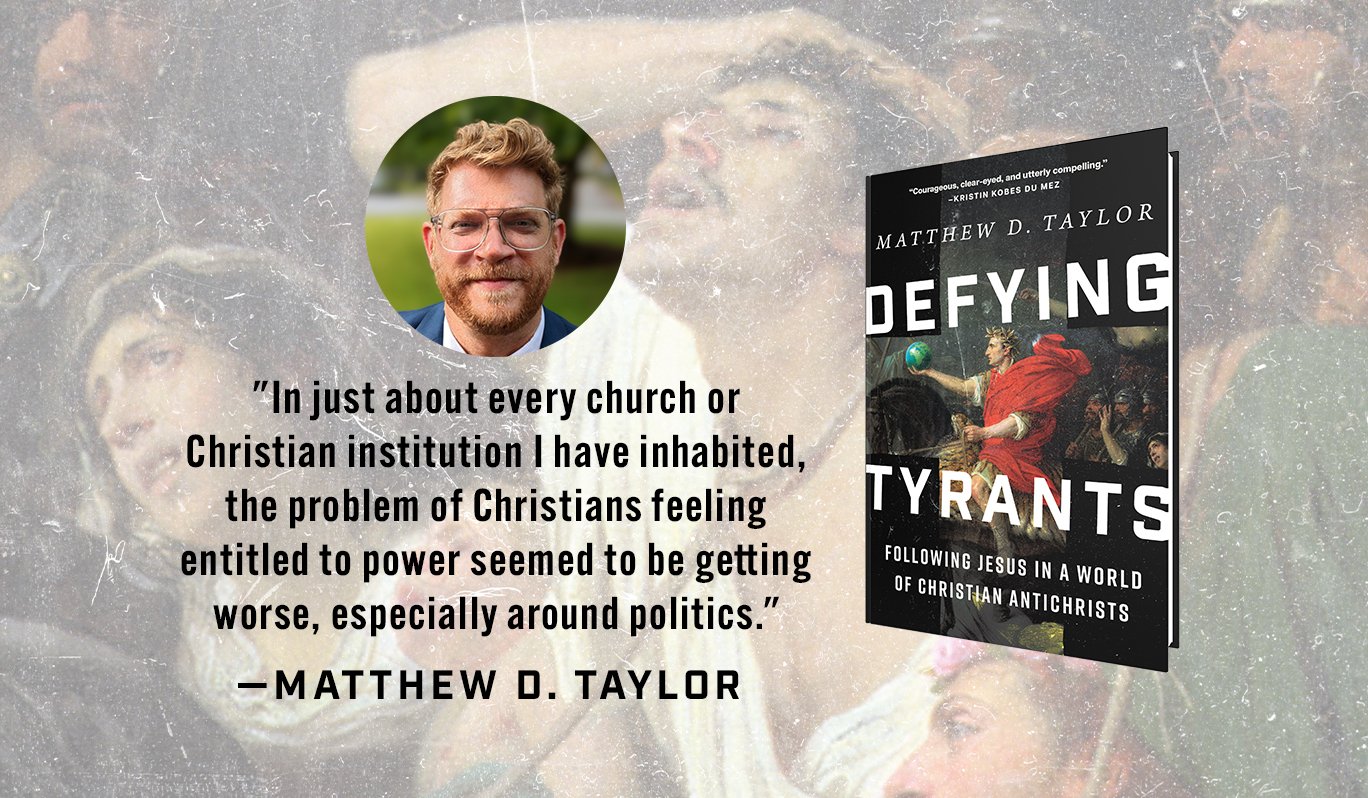
In just about every church or Christian institution I have inhabited, the problem of Christians feeling entitled to power seemed to be getting worse, especially around politics. Most humans want to relish the good and beautiful parts of our traditions. But desperate times call for desperate measures. And these are desperate times.
[](https://hubs.li/Q04wKPb-0)
This is an excerpt from the introduction of [*Defying Tyrants*](https://hubs.li/Q04wKPb-0).
- [Tweet](https://twitter.com/share)
Topics: [Excerpt](https://blog.broadleafbooks.com/topic/excerpt)

#### Written by [Matthew D. Taylor](https://blog.broadleafbooks.com/author/matthew-d-taylor)
Matthew D. Taylor is a religious studies scholar and expert in independent charismatic Christianity and Christian nationalism. He is the creator, writer, and narrator of the Charismatic Revival Fury audio-documentary series on the Straight White American Jesus podcast and author of Scripture People. Taylor holds a PhD in religious studies and Muslim-Christian relations from Georgetown University and an MA in theology from Fuller Theological Seminary. He has served on the faculty of Georgetown University and of George Washington University, and is currently a senior scholar at the Institute for Islamic, Christian, and Jewish Studies in Baltimore.
### Searching for more inspiration? Join our community on social media!
[](https://www.broadleafbooks.com)
©2024 Broadleaf Books. All Rights Reserved.