There are many stories that invent a grand narrative about the Christian past of our nation—a Christian past that, put simply, wasn’t. Some of these stories are false. Some contain a measure of truth, but they are exaggerated in such a way that they become mythical. Those who believe America was or is or should be a Christian nation use these fabrications to create myths about America from the days of the first European arrival to the present.
Americans are divided about their history. A 2022 Pew Research poll found that 60 percent of Americans think the founders intended to create a Christian nation. Among respondents, there was a wide divergence of opinions. By far, white evangelical Christians were the most convinced, with 81 percent saying the United States was intended to be a Christian nation. Black Protestants were less persuaded, with 57 percent believing in a Christian founding. Seventy-six percent of Republicans concurred versus 47 percent of Democrats.
In the main, historians are not divided about the founding. The scholarly consensus is that the separation of church and state is what the founders wanted and is a distinctly American innovation. While most founders were religious to varying degrees, they took concrete steps to prevent the establishment of Christianity. The delegates to the Constitutional Convention declined to include a test of religious belief for public service in the new Constitution. The founders did not dedicate the nation to God in the document. They did not set out to create a Christian form of government.
Yet in contrast to this consensus, many conservative Christian writers teach a Christian past that wasn’t: a collection of Christian myths, folklore, and stories relating to our nation’s past that exaggerate the truth and hijack history. Many of these writers use the stories as a form of propaganda in the service of Christian nationalism, an ideology that combines Christian rhetoric and American nationalism. They teach another founding of America, using myths to claim America was founded as a Christian nation predominantly for white, Anglo-Saxon Protestants.
A significant number of Christian nationalist myths involve the origins and composition of the founding documents (the Declaration of Independence and the Constitution). Myths surrounding the Bible’s influence on the Constitution started to circulate after the framers of that document began to pass away. Were these documents crafted with input from the Bible and Christian theology? During the Constitutional Convention, did the founders consult the Bible to craft the republican government we now enjoy? How much did the Bible influence the founders when they were deliberating?
In the moral sense, the failure of the founders to apply those principles to everyone is one of the key reasons America’s founding cannot be considered a Christian one. The early migrants from Europe came with the mindset that this “new land” belonged to them. The first European colonizers from Spain, Portugal, and then England and the Netherlands all believed they had the right to take land from the Indigenous people. Starting with Christopher Columbus, the doctrine of discovery empowered Europeans to view Indigenous people as savages, enslaving them and treating them brutally. Later, when the English moved into Virginia and Massachusetts, there was some initial cooperation, but the English quickly wanted more land and perpetrated atrocities against the Indigenous people. In the early 1600s, enslaved Africans were brought to Virginia, and the slave trade began. It wasn’t long before slavery in America became based on skin color, and Black people, including their descendants, were enslaved for life.
The atrocities perpetrated on Blacks and Indigenous people persisted unrelentingly through the early history of the nation. Despite the best efforts of Christian nationalists to whitewash history, they cannot erase the stains of this evil. No nation can call itself Christian and operate this way, and yet Christ and his religion were used to justify the plunder and perversion in ongoing, consistent ways. The European migrants came, and in the name of their Christ they expanded freedom for themselves but not for other humans who were here first or for those they enslaved. The Christianity that drove the Europeans was a religion of conquest and colonization.
Our founding fathers crafted the Constitution, and some thanked the “finger of God” for help completing it; yet they refused to lift a manly finger to free the enslaved Africans they fractionally counted in that Constitution only when it benefited the Southern slave states. The Christian Northern delegates to the Constitutional Convention capitulated to the Christian Southern slave-owning delegates, who refused to join the union unless slavery was part of the bargain.
To steal Native land, the Christian fathers forced Indigenous families to walk thousands of miles across as many as nine states. Thousands died of exposure and disease along the march. Later, the government stole Native children away from their parents. They were consigned to Christian boarding schools to study the Bible and learn the Ten Commandments, many of which the Christian fathers violated in God’s name. As historian Jemar Tisby has said, Christ’s name was taken in vain. His name was blasphemed and used to do despicable things.
So, when I say America was not founded as a Christian nation, I mean two things. First, I mean this in a legal sense. The founders did not dedicate the nation to the Christian God, they didn’t require office holders to be Christian, and they declined to establish Christianity as the state religion. Second, the actions of the founders and founding generation put aside the “love your neighbor as yourself” Christianity of Jesus for a political Christianity of the sword when, among other sins, they established race-based slavery, violated Indigenous lands and treaties, and failed to recognize women as full human beings.
If you persist and say America was founded as a Christian nation, you should say it in shame, not triumph. For as surely as there is a Christian past that wasn’t, there is indeed a Christian past that was. In this Christian past that was, the state used religion for justification of atrocities and evil, and the church complied to maintain political power. At times, the established church persecuted dissenters who named the same Savior as Lord in order to keep their earthly power. In the Christian present, Christian nationalists want a similar kind of political dominance.
This book is published as the United States is celebrating the nation’s semiquincentennial, or 250-year anniversary of independence. If the nation’s bicentennial celebration in 1976 serves as any guide, there is likely to be a swell of Christian nationalist books, podcasts, and discussion throughout the land. We have become a nation of two approaches to American history: a Christian nationalist version and a version that recognizes separation of church and state. One version sanitizes and whitewashes the past, while the other is subject to modification based on research, peer review, and new information. The Christian Past That Wasn’t calls us to the second version. I invite you to join me in seeking that history.
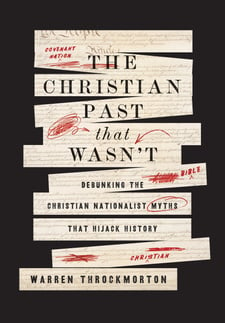
This is an excerpt from the introduction of The Christian Past That Wasn’t.