---
title: How Does Someone Become a Conspiracist?
description: Why are more women becoming radicalized by conspiracy theories? The Conspiracists explores the things that may result in someone becoming a conspiracist.
image: https://blog.broadleafbooks.com/hubfs/Broadleaf%20Books/Spring_2026/Blog_Assets/BL_TheConspiracists_BlogBanner.jpg
---
[](https://www.broadleafbooks.com)
- [Excerpts](https://blog.broadleafbooks.com/tag/excerpt)
- [Interviews](https://blog.broadleafbooks.com/tag/interviews)
- [Op-Eds](https://blog.broadleafbooks.com/tag/op-ed)
- [Resources](https://blog.broadleafbooks.com/tag/resources)
- [Shop Now](https://www.broadleafbooks.com/store/search/allproducts)
## [How Does Someone Become a Conspiracist?](https://blog.broadleafbooks.com/how-does-someone-become-a-conspiracist)
Dec 22, 2025 9:12:00 AM / by [Noelle Cook](https://blog.broadleafbooks.com/author/noelle-cook)
[](https://www.broadleafbooks.com/store/product/9798889832423/The-Conspiracists)
One afternoon as I was doing research for this book, I found myself reading about the personality profile of a conspiracist. A massive 2023 study of “The Conspiratorial Mind” by the American Psychological Association (APA) summarizes all the available research on the personality traits most common among conspiracists. According to the APA, conspiracists are “insecure, paranoid, emotionally volatile, impulsive, suspicious, withdrawn.” Conspiracists tend to believe the world is a dangerous place and display cynicism, powerlessness, anxiety, a sense of alienation, and depression.
Reading that list of descriptors, I felt a strange sensation of creeping familiarity. It was not unlike the feeling you get when an internet search of your aches and pains returns a list of catastrophic diseases. You don’t *really* think you have meningitis, stage-4 cancer, or a rare-but-fatal skin disorder . . . but what is that rash, anyway? And why do I have lower back pain, a persistent headache, *and* dry mouth?
I couldn’t ignore the fit. Insecure, emotionally volatile, impulsive, cynical, anxious: the traits identified with the psychology of conspiracy theorists described me, with some accuracy, three years after COVID shut down the world. Even now that things had opened back up, the symptoms of my emotional hangover from the pandemic lingered. I saw the same symptoms among many of my friends and family members as well. We were all still feeling powerless, and paranoid, and suspicious, and withdrawn.
And yet, I do not believe in conspiracy theories, nor do any of my close friends or family. I don’t believe that pedophile Satanists secretly run the world, or that COVID vaccinations implant mind-controlling nanochips. So, I started to wonder: What separates non-conspiracists like me, who can tick the boxes on “The Conspiratorial Mind” checklist, from those who fall prey to conspiracy theories? The women I study have fallen deeply into worlds of conspiracism. Why have I rejected conspiracy theories while they ended up refashioning their lives around them?
The reason that some people believe conspiracy theories is not entirely rooted in the information sources to which they turn. While misinformation is more likely to circulate on right-wing media, it’s also not the case that everyone who watches Fox News or One America News Network is a dyed-in-the-wool conspiracist. In most cases, other factors are at work, many of them dealing with personal traits and experiences that drive certain people to believe in conspiracies.
Most scholarship on conspiracism focuses on the questions of *who* adopts conspiracy theories and *why* they turn to them. Initially, many researchers thought conspiracism was a neurological disorder. Early studies targeted the strong correlation between belief in conspiracy theories and schizophrenia, bipolar disorder, and other illnesses rooted in brain chemistry.
That link is real, but it only accounts for a subset of those who turn to conspiracies. Chemical imbalances in the brain cannot explain why a significant portion of the US population believes in QAnon or conspirituality. The neurological theory does not explain why so many Republicans think the 2020 presidential election was stolen and the COVID pandemic was a hoax. Something else is clearly at work.
Moving beyond neurological explanations, researchers tried to identify conspiracists based on demographic factors and the role played by things like age, race, sex, income, education, and political affiliation. The findings were mixed and often contradictory. Some studies showed that older women were more prone to conspiracism, others found that sex and age made no difference, and another batch found that younger men were more likely to fall into conspiracies. One of the few constants seems to be the strong correlation between conspiracism and lower levels of income and education. Early studies also showed that ethnic and racial minorities were more prone to believe conspiracy theories related to systemic racism, like the belief held by many African Americans that the government created HIV/AIDS to kill Black people.
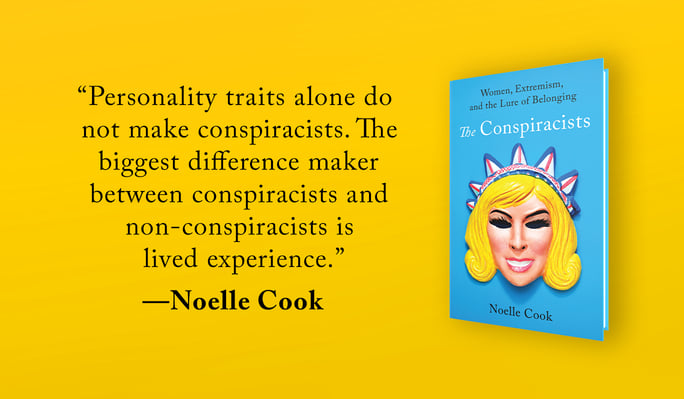
Newer research suggests that falling into conspiracism is a dynamic process. Recent studies have shown that personality traits alone do not make conspiracists. What matters is how those traits interact with other factors. The biggest difference maker between conspiracists and non-conspiracists is lived experience. It’s not so much that people have certain personality traits that automatically make them into conspiracists; it’s that certain kinds of life experiences tend to drive people with those traits into conspiratorial thinking.
In considering why people turn to conspiracism, recent scholarship tends to focus on the role played by life stressors, especially deep and chronic trauma. Over time, heavy life stressors can create a sense of powerlessness, insecurity, and anxiety that can lead people into conspiratorial thinking. That’s especially true in cases of post-traumatic stress disorder (PTSD) and complex PTSD, which is essentially the repeated and prolonged version. When life stressors become intense, people with long histories of trauma often turn to extreme beliefs like conspiracy theories to make sense of what they are going through. It’s easier for some people to explain the things happening to them as part of a grand nefarious plot than to accept the inherent chaos, structural inequity, systemic cruelty, or indifference that characterizes much of life.
In these cases, researchers suggest that conspiracism is a method for enduring the complexity and pain of life—*Conspiracy Beliefs as Coping Behavior*, as the title of one recent book puts it. For those who experience chronic “anxiety, loneliness, and a sense of powerlessness,” research finds that embracing conspiracy theories “may in some way offer them relief from their stressors,” write authors Helen Hendy and Pamela Black. That seems to be especially true when intense new life stressors fall on top of existing PTSD or complex PTSD symptoms. Their research suggests a sequence where “individuals who face intense *life stressors* (health, money, loneliness), and who experience symptoms of *powerlessness*, become at increased risk for adoption of *extreme beliefs* as cognitive coping mechanisms that might restore their sense of power and community.”
All this suggests that we need to approach conspiracism with a measure of care and understanding. If you’re a non-believer, it’s easy to dismiss conspiracy theories as outlandish crazy talk and the conspiracists themselves as xenophobic, antisemitic, or racist dupes. That is true in certain cases, and nothing excuses dehumanizing rhetoric. But the massive wave of conspiracism currently spreading across the globe defies easy analysis. Understanding the scope and depth of the problem—and finding effective solutions—requires that we come to terms with the ways that people turn to conspiracy theories to cope with their pain and anguish.
In the end, the big difference between me and the women I study might be that they experienced intense life stressors and PTSD events going back to childhood. We may share certain markers of “the conspiratorial mind,” but part of what separates us is that they experienced an unusual level of trauma in their childhoods that carried over into adulthood and I did not. I have found this to be a common pattern among the January 6 women I have gotten to know who embrace various strains of conspiracism. Nearly all of them cite traumatic childhoods and significant life traumas as formative experiences in their lives. Their history of personal trauma is always one of the first things they mention when we talk.
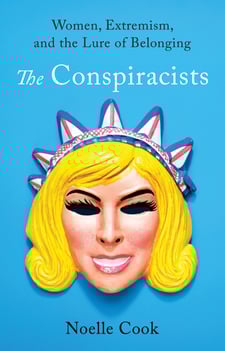
Trauma histories abound, for so many people, and reading about other people’s trauma can enliven memories of our own. In *[The Conspiracists](https://www.broadleafbooks.com/store/product/9798889832423/The-Conspiracists),* I present Tammy’s and Yvonne’s histories of trauma not to intrude on their privacy or to surface anyone else’s traumatic memories but simply to offer a fuller picture of how childhood trauma interacts with conspiracism. For Tammy and Yvonne, it wasn’t just one or two traumatic incidents. Their paths to conspiracism were blasted out by a constant firehose of trauma that began in childhood and kept blowing open new pathways deep into adulthood. Researchers continue to explore the links between trauma and conspiracism, and much work remains to be done. But it doesn’t take a lot of data to see the ways in which conspiratorial thinking, at root, dissociates someone from reality, allowing them to live in an alternate world of possibility and illusion where they are better able to handle what life has handed them.
[](https://www.broadleafbooks.com/store/product/9798889832423/The-Conspiracists)
This is an excerpt from *[The Conspiracists](https://www.broadleafbooks.com/store/product/9798889832423/The-Conspiracists)* chapter 2: Trauma.
- [Tweet](https://twitter.com/share)
Topics: [Excerpt](https://blog.broadleafbooks.com/topic/excerpt)

#### Written by [Noelle Cook](https://blog.broadleafbooks.com/author/noelle-cook)
Noelle Cook is an ethnographer and researcher specializing in the online and offline participation of women in conspiratorial and right-wing movements. As an associate producer of The Conspiracists, a feature documentary by Page75 Productions, Cook examines how identity, belief, and belonging shape extremist communities. Her work bridges academia and media to explore the forces driving radicalization.
### Searching for more inspiration? Join our community on social media!
[](https://www.broadleafbooks.com)
©2024 Broadleaf Books. All Rights Reserved.