CHICAGO, FEBRUARY 20, 2013
From the glow of my laptop screen tucked away in coffee shops with strong Wi-Fi, I was a hidden digital disciple, pulling the strings behind the curtain, iced coffee in hand, like a Christian version of the Wizard of Oz.
My fingers flew across the keyboard with a sense of purpose, as I knew the words I typed would shape how millions of people experienced faith. One social media post could spark hope, comfort someone on the brink, or fill an arena-sized megachurch.
Throughout the early 2010s, if you had any connection to evangelical Christianity, you would have likely seen my work even if you had never known my name. That was by design. I was part of the megachurch media machine, crafting faith-filled posts for millions while quietly wondering if there was a place for me in the churches and ministries I was helping build.
I started my workday by publishing a Facebook post promoting The Global Leadership Summit, essentially the TED Conference for Christian pastors. More than ten thousand people would pack into Willow Creek Community Church—a megachurch in suburban Chicago that looked more like a shopping mall—while two hundred thousand more across seventy countries tuned in from satellite viewing locations. Business leaders, academics, entrepreneurs, and household names like Brené Brown, Bono, Melinda Gates, former President Bill Clinton, and Fortune 500 CEOs regularly shared the stage with celebrity pastors. It was the ultimate blurring of sacred and secular. Church and state comingling under the banner of Christian leadership.
Shifting my attention to my iPhone, I prepped an Instagram post for Judah Smith, a Seattle pastor with a cultlike social media following. With his athletic physique, chiseled jawline, and haute couture wardrobe, he looked more like a model strutting the runways of New York Fashion Week than a preacher. I was helping him promote his first book when we hit the jackpot: Justin Bieber posted about it. The post triggered a chain reaction of morning talk shows, news coverage, and a coveted spot on the New York Times bestsellers list. The world now knew Judah as Justin Bieber’s pastor. I, meanwhile, became a Belieber in the power of social media long before #BookTok was a thing.
Returning to my laptop, I answered an email from the head of Hillsong Music. The Grammy-winning band from an Australian megachurch had sold more than twelve million albums, regularly topping Billboard charts, and their songs were sung by an estimated fifty million people in sixty languages each week. The band’s music was so popular the church established its own denomination with churches in thirty countries attracting more than one hundred and fifty thousand attendees. Hillsong had hired me to help them promote their next live worship album, and I’d be headed to Sydney in a few months’ time.
Just as I hit send on the email to confirm my flights, a loud Bruuup! broke the quiet. A familiar surge of panic flooded my system. Heads turned. My face flushed as I fumbled to silence my phone. Some of the male patrons chuckled knowingly. The unmistakable sound had come from Grindr, the gay dating app.
The irony was not lost on me. Here I was sitting in a queer coffee shop in Boystown, Chicago’s LGBTQ+ neighborhood, hustling for Jesus while chatting on Grindr with a man named Jesús.
Even then, three years after I had dropped out of conversion therapy, my body still responded with the instinctive fear of being caught and the dread of having to confess my sins like I had for nearly eight years.
It was a routine I knew too well in a therapist’s office or on folding chairs in a church basement. Leg shaking, shirt soaked through with sweat as I confessed the ways I’d “acted out” that week.
“What do you think led you to fall again?” my therapist would ask like a loving but very disappointed parent.
“I don’t know,” I’d respond. “I don’t mean to. I pray. I do everything I am supposed to, but it just . . . happens.”
“You’ll get there,” he would say with hope in his voice. “God’s just refining you.”
I would nod my head in agreement. I believed him because I thought I had to.
For me, conversion therapy wasn’t boot camps or electroshock treatments, though those did happen, were horrifying, and left deep emotional and psychological scars. Mine was a gentler version of conversion therapy—if you can even call it that—because how gentle can something be if it teaches you to hate yourself?
I did weekly sessions with a quack Christian therapist who treated my desire for love and connection like a disease. The prescription was Bible verses and prayers to repeat whenever unwanted “same-sex attraction” surfaced. I also went to week-long conferences with “ex-gay” speakers where we were taught how to heal our homosexuality by having close relationships with straight men and doing everything we could to act more like them. And I did support groups that felt like AA for homosexuality, only with more shame and fewer success stories.
With all my best but futile efforts, I was trying to kill a part of myself I hadn’t even had the chance to understand because I believed that’s what God wanted me to do.
Even years later, the echo of those rooms was still loud. Shame and religious trauma have a tendency to follow you wherever you go.
Back in the coffee shop, the barista called out someone’s order and snapped me back to reality. I was okay. Or at least I told myself I was. I silenced my notifications and took a deep breath.
The show must go on.
I was one of the invisible architects behind evangelicalism’s digital transformation. While megachurch pastors became influencers, worship leaders became rock stars, and megachurches became lifestyle brands, I remained in the shadows, crafting their messages, building their platforms, and shaping their digital personas. I knew how to position them to appear culturally relevant and welcoming while carefully avoiding any messaging that might alienate their core conservative base.
I was living proof of their unspoken rules: I was useful in the shadows but unacceptable in the light. I worked for institutions that wouldn’t accept someone like me, yet they eagerly embraced my talent for making them appear progressive and inclusive. I made Christianity look culturally relevant and connected—all while feeling increasingly disconnected from it myself. My job was to convince the world that these churches welcomed everyone when I knew firsthand the conditional nature of that welcome.
Each perfectly composed tweet, each carefully filtered Instagram post, and each viral video was part of a larger deception. We were selling belonging, a family for the lonely, but delivered exclusion. We promoted grace and acceptance but practiced judgment. And we preached authenticity while demanding conformity. It was the great paradox of modern evangelicalism.
Still, the real magic trick wasn’t just transforming these pastors into influencers, but it was maintaining my own double life.
By day, I was a digital evangelist expanding the reach of churches across the globe. By night, I was just beginning to learn how to be free to be myself as a gay man. But in a world that increasingly felt fragmented, the cracks were beginning to show.
As I closed my laptop each evening, I couldn’t help but wonder how long I could keep the illusion going. The line between making evangelism cool and making evangelicals seem more progressive than they really were had long since blurred. And somewhere along the way, I’d lost sight of where their performance ended and mine began.
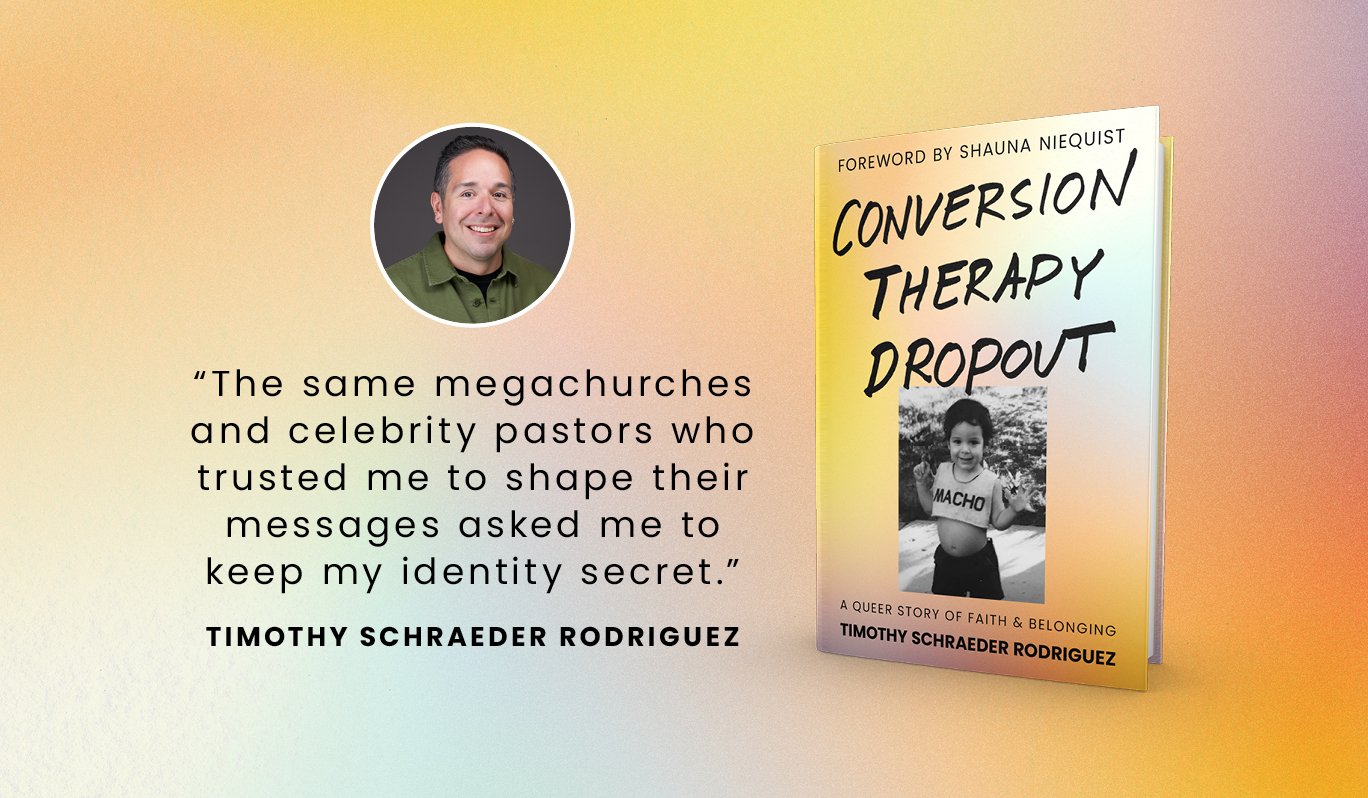
This was my reality: The same megachurches and celebrity pastors who trusted me to shape their messages asked me to keep my identity secret. I was gay—and somehow still a Christian. Like other facets of my identity—being adopted and maintaining a relationship with my biological family, being Mexican American, and being a sober alcoholic—I had become adept at living in contradictions.
At first, I was okay with the arrangement. The churches valued what I could do for them. If I stayed in the shadows, they were happy to pretend my sexuality didn’t exist. But eventually, the price of my silence became too high—a cost I had been paying long before I ever stepped into a megachurch marketing role.
The journey to owning my gay identity has been long, including eight years in conversion therapy, where I fervently tried to pray my gay demons away. Despite all my efforts, my prayers to be straight went unanswered. I feared that coming out would mean the end of my church career when in fact, it was only just the beginning.
Conversion Therapy Dropout isn’t your typical “coming of gay” memoir, a harrowing conversion therapy survival story, or a tell-all exposé of evangelical megachurch scandals—though all of that is in here. This is about living in the spaces between certainties, in the messy middle where most of us actually live. And how I managed to keep my faith without losing my soul.
This is an excerpt from the Conversion Therapy Dropout introduction: Hiding in Plain Sight.