---
title: Modern-Day Fascism in America
description: Fascism is here. What can we do about it? Shadows of the Republic by Omer Aziz explores American fascism and what we can do to salvage democracy.
image: https://blog.broadleafbooks.com/hubfs/Broadleaf%20Books/Spring_2026/Blog_Assets/BL_ShadowsOfTheRepublic_BlogBanner.jpg
---
[](https://www.broadleafbooks.com)
- [Excerpts](https://blog.broadleafbooks.com/tag/excerpt)
- [Interviews](https://blog.broadleafbooks.com/tag/interviews)
- [Op-Eds](https://blog.broadleafbooks.com/tag/op-ed)
- [Resources](https://blog.broadleafbooks.com/tag/resources)
- [Shop Now](https://www.broadleafbooks.com/store/search/allproducts)
## [Modern-Day Fascism in America](https://blog.broadleafbooks.com/modern-day-fascism-in-america)
Mar 6, 2026 9:14:00 AM / by [Omer Aziz](https://blog.broadleafbooks.com/author/omer-aziz)
The light dims over democracy. Across America and the entire Western world, fascism is making a resurgence, taking down liberal democracy, imposing authoritarian rule, and targeting immigrants and minorities. Armed agents of the state, wearing masks and regular clothes fortified by body armor, make innocent people disappear and reward criminals who have violently attacked democracy. Militias spread terror on the streets. Far-right politicians win power from America to Germany and in countries around the world. As liberal democracy collapses in on itself, we have reached the end of history that was predicted in the late 1980s. Fascism rises, although not for the first time. If there ever was a new fascist era, we are currently living through it.
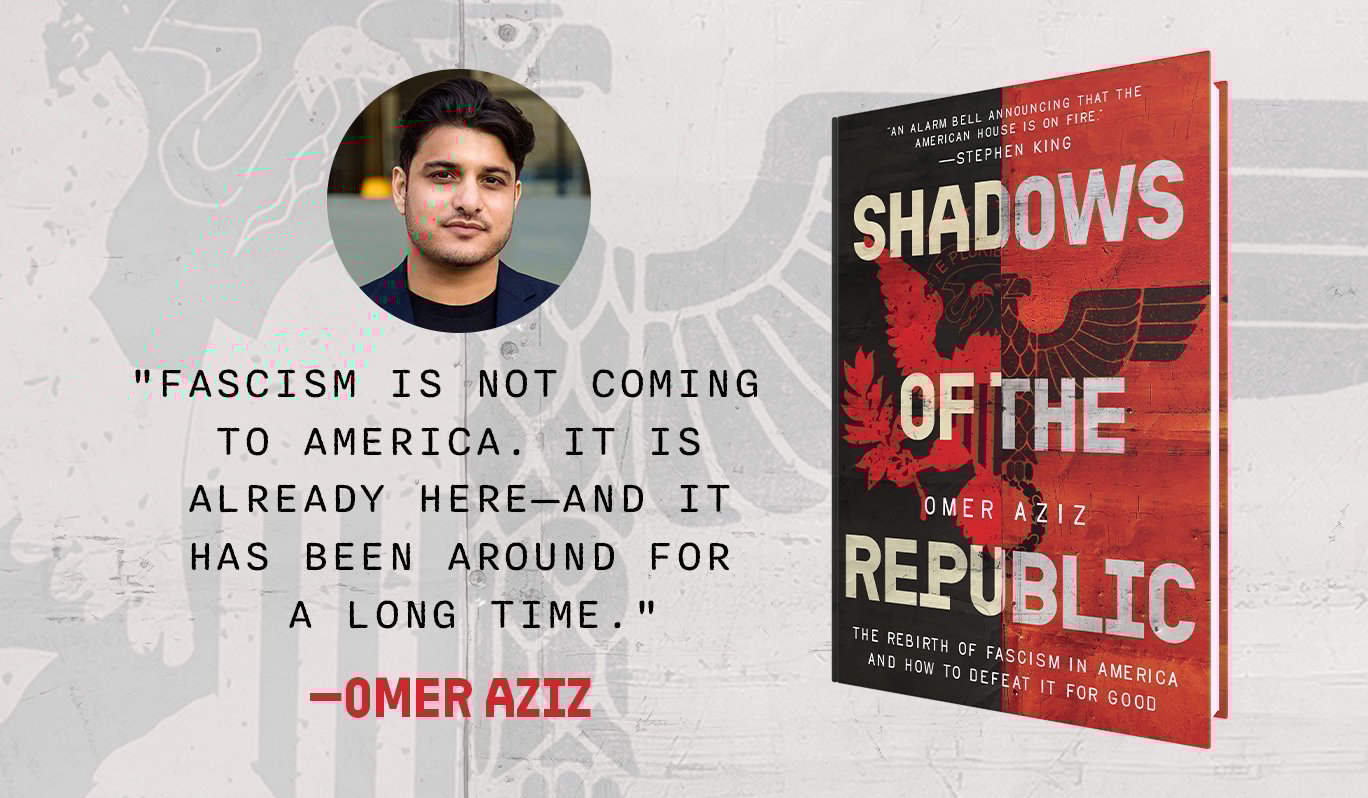
Fascism is not coming to America. It is already here—and it has been around for a long time. We can see it in different guises: anti-immigrant mobs, the Klan’s hooded rallies in the 1920s, the post-9/11 emergency state, the masked and plainclothes agents of the state snatching people off the streets. The president who invokes and provokes emergencies to militarize the crisis and seize greater power. The militants on the streets and those in halls of power. The libraries and schools that ban books—schools banned over four thousand books in 2024.
Fascism is rooted in old ideas, in the original racial codes and mindset that sought to destroy Indigenous peoples across North America. The capital-F Fascism of Italy and Nazism of Hitler, when they first appeared in the 1920s, were influenced by—and then influenced in return—the far-right ideas already present in America. When Hitler described the ideal racial restrictions necessary in immigration, writing in his unpublished Second Book, he turned to the United States, where certain races were banned entirely from immigrating, as a prime example. The leadership style of the Great Leader standing above the state, beyond law—the Führerprinzip—is also rooted in ideas of rulership and racial domination. The fascist state is the mafia state, the regime that uses brute force, manipulation, and power to achieve its ends, creating a vacuum of law and, eventually, humanity.
Misunderstanding how fascism arose, we have responded with neoliberal niceties. We have forgotten the lessons of the original fascists, when they consolidated power and destroyed democracy from within. In America, collective amnesia precedes collective hallucinations, and now this country lives through an authoritarian nightmare that violates the Constitution, upends centuries of norms, and controls a massive surveillance state that knows everything about us. From America to Germany to the non-Western world, from fashion to politics, fascism has returned and adapted to the modern era.
Today, fascism is ascending globally, changing politics, culture, and technology from within. This is not hyperbole, and as the story in the following pages will show, the interconnections between American history and fascism run deep. Fascism is surging today because, as a movement, it was never entirely defeated. *Fascism*—a word drawn from the *fasces*, or the bundle of rods and axe carried by the lictors in Rome and symbolizing executive power—is a militarized version of order and hierarchy. It is a weaponized government and a terrorized population, a mass party and a cult in power. It is a movement and an idea. Despite going underground after World War II, it has returned. Fascism is indigenous to Western democracy, and the right social and economic circumstances have now converged to give this movement room to flourish.
Modern fascism exists in several concentric circles. In the middle is the neo-Nazi thug, ready to commit murder tomorrow. In the next circle are militias and gangs that harass minorities and civilians, groups like the Proud Boys, the Oath Keepers, Patriot Front, and the NSC-131 members that stormed Cambridge on a placid Sunday afternoon in 2022. In the following circle are elements of the MAGA movement focused on immigrants “poisoning the blood” of the country and women having too many rights. Others want a technological autocracy or a traditionalist Christian nation. The final circle is the intellectuals and influencers who feed into the other circles’ ideas: about birthrate theories of race, grand conspiracies about the elite, and legal strategies to turn America into a monarchy—without a king per se, but with a Roman-style dictator. Technology amplifies and accelerates fascism’s appeal, which is directly reaching young people, especially young men, drawing in an entire generation.
Fascism goes to the heart of America. Here, in the land of the free, fascism has its own uniquely American roots, which were always in direct conversation with European fascism. The victims of twentieth-century European fascism, and the victims of nineteenth-century American violence, do not sleep. They haunt us, and they challenge our democracies not to fall into darkness again.
Fascism provokes an emergency, instigates a crisis—and then steps in to take absolute power. The movement evokes the images of the swastikas, jackboots, and marches. The mass rallies and book burnings. The concentration camp and the death camp. The shadows cast by the films and documentaries that capture fascism’s aesthetics—they haunt and trial democracy.
Yet we make a mistake when we assume that fascism is foreign or that it must bear the swastika; we stumble when we conclude that fascism today must be an exact copy of what came before. Fascism is adaptive, flexible. It is a chameleon shifting with the light—now a white supremacist’s shriek against the stranger, now an oligarch’s handshake with power, now an immigrant kid getting snatched off the street and sent to a secret prison beyond the reach of the law. Millions of people look away, ignore the threat, downplay it—and thus fascism proliferates.
The fascists create a legal black hole where people will be erased—literally dehumanized—and expand a monstrous surveillance state and machinery of terror that will continue to ensnare new victims. This fascist resurgence did not happen overnight and will not be defeated so easily.
The Swiss psychiatrist Carl Gustav Jung spoke of the “shadow” that we all carry: that buried part of us where we’d rather not look, that part of us that contains all our capabilities of potential evil. All humans have this shadow. Our human tendency to lie, to manipulate, to be self-serving at the expense of our community, to flaunt wealth. We prefer to ignore any such traits in ourselves, even while we detect them swiftly in others. Democracies have this shadow too. While we say we value elections, judicial independence, equality before the law, meritocracy, and decency, some part of our society yearns for authoritarian rule and punishing anyone who transgresses—minorities, women, dissidents. Democracy works by voluntary participation and civic engagement; its dark underbelly is one of revenge and retribution.
Fascism is the shadow of democracy. And when this shadow takes over, it manipulates the masses into hallucinatory fantasies of egotistical power and cruelty. It gives them license to commit savagery, treachery, and injustice. Through fascism’s charms and illusions, entire societies become collectively possessed. The demon takes over.
As a millennial, I witnessed how young men around me were drifting to the far right and that people of all colors were beginning to use the rhetoric of far-right nationalists. It was not that these people were lost but that liberal democracy and American society had failed to offer them substantive policies and meaning, to give them a purpose beyond self-enrichment and fame. There is a reason why, in the aftermath of the global financial crisis of 2008, conservative parties swept across America and Europe and then populist parties gained even more power. Fascism emerges when the ideals of liberal democracy are neglected.
When fully realized, fascism wins by feeding off democracy like a parasite, eliminating the humanity in each of us. Even the rational and compassionate person, who has a natural instinct toward justice and a strong sense of right and wrong, may begin to falter. Fascism destroys the human in us, making us either victims, bystanders, or perpetrators—even passive perpetrators—of machineries of terror.
This is an excerpt from the prologue to *The Shadows of the Republic*.
- [Tweet](https://twitter.com/share)
Topics: [Excerpt](https://blog.broadleafbooks.com/topic/excerpt)

#### Written by [Omer Aziz](https://blog.broadleafbooks.com/author/omer-aziz)
Omer Aziz is a writer, lawyer, and former foreign policy advisor. He is the author of Brown Boy and has held residencies at MacDowell and Yaddo and was most recently a Fellow at Harvard's Radcliffe Institute. His essays have appeared in The Atlantic, Harper's, New York, and the New York Times, among other publications. Born to a working-class immigrant family, Aziz earned his BA with honors in politics from Queen's University, his MPhil in international relations from the University of Cambridge, and his JD from Yale Law School.
### Searching for more inspiration? Join our community on social media!
[](https://www.broadleafbooks.com)
©2024 Broadleaf Books. All Rights Reserved.