Decades into the Christian Right’s ascent, it can be hard to recall the other version of Jesus: the hierarchy-bucking iconoclast whose followers included women, outcasts, and pariahs. Christianity’s earliest phase was a table-flipping, Pharisee-questioning, defending-women-and-the-poor, threat-to-the-empire sort of movement. It was only as the church organized and grew that it became a body led by a male priesthood. Then, its canonized texts and doctrines largely left out, and denied, the ministries led by women.
But women stuck with the church for millennia, finding places to root their faith even amid hypocrisy and abuse. Sixteenth-century French women were threatened, harassed, and raped by priests who could refuse absolution, deny the sacraments, and otherwise weaponize the faith against victims. In France, Germany, and other parts of Europe, priests interrogated women in confession, trying to extract intimate sexual details. Hundreds of supposedly celibate European priests had concubines.
In the colonial United States, in a time of high child mortality, women like 1760s revivalist Sarah Osborn tormented themselves, imagining their children damned, lost before they could make the choice to be saved. Still, women clung to their faith and served the church. They found solace in stories of faith and resilience. They hoped for God’s blessing and for those they loved to be saved.
Yet up until the nineteenth century, American women were locked out of leadership roles in major denominations—and still are today in many churches. But they filled the pews and, reminiscent of a good Victorian mother, served as the “angel in the house,” a domestic keeper of the family’s faith and morality. Even after second-wave feminism’s inception in the 1960s, women typically stitched together churches’ social fabric—maintaining the community by caring for the sick and grieving and nurturing faith in the next generation. They prayed for the ailing, supported their church friends through the death of spouses and children, taught Sunday school, ran the nurseries and pancake breakfasts and fellowship coffee hours. They were offered a spatula and percolator, if not a pulpit.
These days, though, many churches don’t have enough members to fill a fellowship hall. Some are shuttering. Those still up and running may want to start flipping their own pancakes.

As the adage goes, across the globe, women tend to be more religious than men. There are some countries in which men and women do affiliate in roughly the same numbers—where nearly everyone is religious, so faith is a norm across the board. In countries where there is a gender gap, however, women are usually more religious. There are no countries in the world where men are more religious than women by more than two percentage points. Scholars who trace the rise of secularism in other countries note that when larger numbers of women begin leaving the predominant religion, secularism is really taking hold.
There are a few interesting exceptions to the “women are more religious than men” rule: one is Sikhism, which also values equality as a central tenet. In the US, there’s no statistical difference in Jewish men’s and Jewish women’s attendance of religious services. While American Muslim men do attend services more frequently than Muslim women, this may be a product of religious rules. (Muslim men are expected to attend Friday midday prayers at the mosque.) Of course, attendance is not the only way to show religious commitment. In some ways, it depends on what you are measuring when you ask if someone is “religious.” While surveys show Muslim men and women say religion is “very important” to them at similar rates, Muslim women report praying daily more than men. In the US, Muslim, Christian, Jewish, Hindu, and Buddhist women all pray daily at higher rates than their male counterparts.
American Christianity is the example that used to really define the rule of women’s religious primacy. Not only have American women historically outstripped men in a range of religious practices, but American men and women both tended to be more religious than people from other economically advanced countries, including Canada and the UK. While Europe secularized, America—maybe because of our religious freedoms—kept the faith. Even religiously unaffiliated American women tend to light candles or incense for spiritual reasons, read their horoscope, or consult a fortune teller more than unaffiliated men do.
Yet as the total population of American Christians shrinks, the gender gap is starting to close. In some cases, it’s looking like it may flip, with many studies showing younger women (Gen Z or Zoomers) starting to disaffiliate from religion faster than men are. While millennials overall tend to be a smidge more religious than Zoomers, there is evidence that the religious gender gap among millennials has disappeared too, with men and women bucking religious identification in equal numbers.
Studies also suggest that the active faith of mothers is a strong predictor of the later religious affiliation of her kids. So it matters—for the longevity of a particular faith now and for the next generation—when women quit.
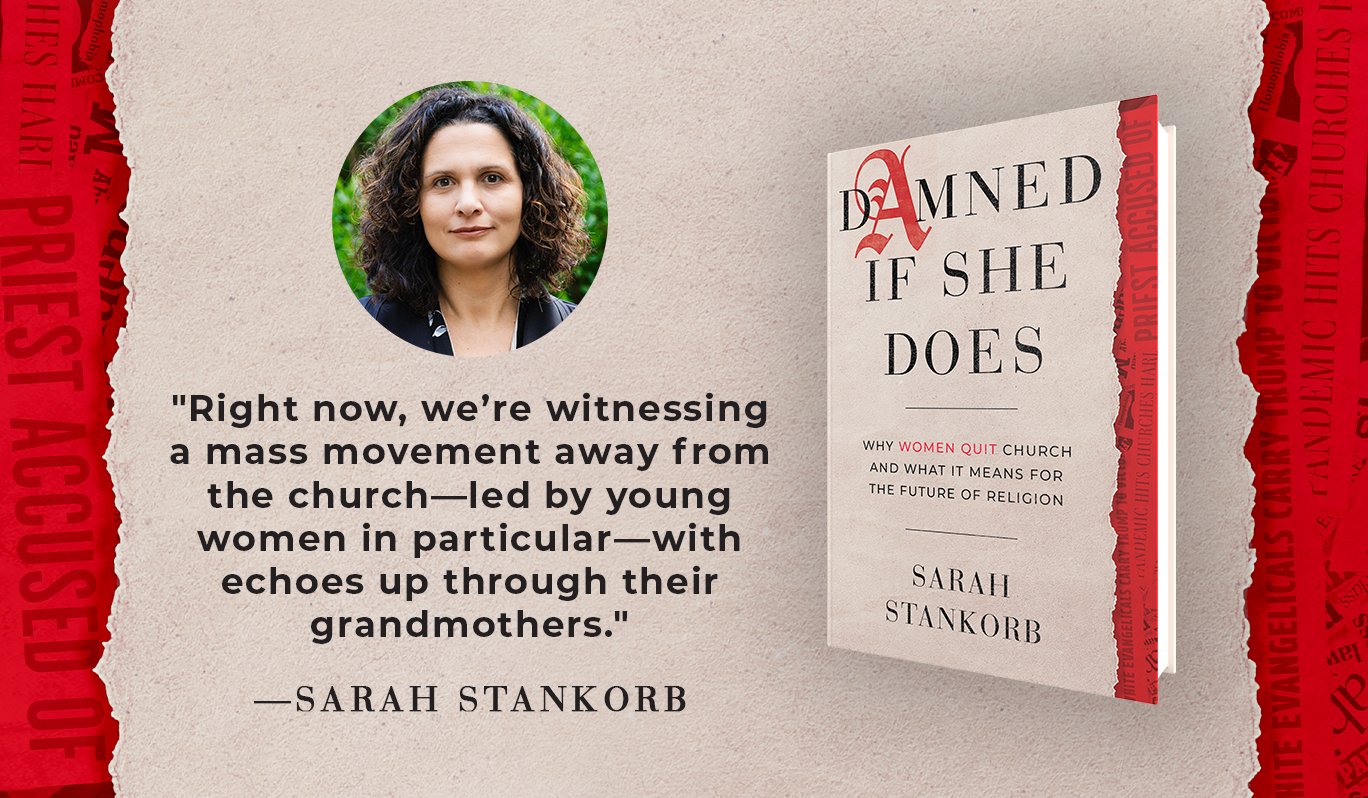
While older women are sticking with the church more than their daughters and granddaughters, with each successive generation, the substance binding women to the church seems to be thinning. It’s like a glue that is getting diluted with each younger generation. The glue’s “stickiness” is starting to fail at every age. Some of the factors—that sticky residue—that used to tug older people back to the church with age no longer have the same retractive pull. At the same time, many younger women, plenty of whom were brought up by mothers who had their own breakup with the church, have little interest in sticking around. Young or older, there is no birth cohort, regardless of gender, that is as religious as it was fifteen years ago. Right now, we’re witnessing a mass movement away from the church—led by young women in particular—with echoes up through their grandmothers.
This story of women leaving the church is revealed in statistics but better understood in the intimate accounting of heartbreak: churches that tried to suppress them or were silent on racism or sexual abuse but loud on abortion or gay marriage or how to vote. Many of the women you will meet in these pages used to be deeply committed to the church: They went to church many days of the week. They prayed. They taught (sometimes only women and children) and served on worship committees. Their faith dictated how they voted in national elections. A few were ministers. Some were sexually abused within the church, or shamed for their sexuality, or encountered clergy who didn’t address real dangers they faced as women or people of color. Some noticed faith leaders treating believers like political pawns. Most were deeply devout; leaving was agonizing. A few never felt a deep connection and simply realized one day that they didn’t have to stay. At some point, most figured that within the church, they’re damned if they stay and damned if they go. So they might as well go.
Some sociologists speculate that a segment of currently nonreligious Americans used to claim affiliation in name only. Maybe they were born Catholic or Baptist but rarely or never attended religious services or just never especially cared deeply about church. Social pressure used to make it easier for people to simply say they were Christians even when it was a lie. But now that the stigma is diminishing around irreligion, they are freer to own up to disbelief or disaffiliation.
This may be true for some. But women’s exodus from church is far more significant than a culturally acceptable soft-quit by people who never really cared all that much. Their collective experiences indicate a recalibration of American values, a spiritual and ideological reorganization. Whatever Christian faith’s underlying influence in our civil sphere, this fresh vacancy leaves space to redefine or, perhaps, rediscover what ties have bound us as Americans all along.
This is an excerpt from the introduction of Damned If She Does.